Patient experience intelligence for hospital groups
Demo prototypeHyve Vitals
This is what a discovery deliverable looks like when you can open it. Not a slide deck describing a system, and not a system — a working model of one, built so the people who would use it can disagree with it while disagreeing is still cheap.
The problem
Hospital groups are paid partly on patient experience scores, and the money at risk is large enough to matter. The scores arrive as survey composites, months late, averaged across a whole hospital — which is precisely the level at which nothing can be acted on.
The hard part is not the dashboard. It is the chain: a score moves, something specific caused it, someone owns the fix, and the fix has to be measured on the same metric that flagged the problem. Get that chain wrong in the data model and no amount of interface work rescues it.
The system
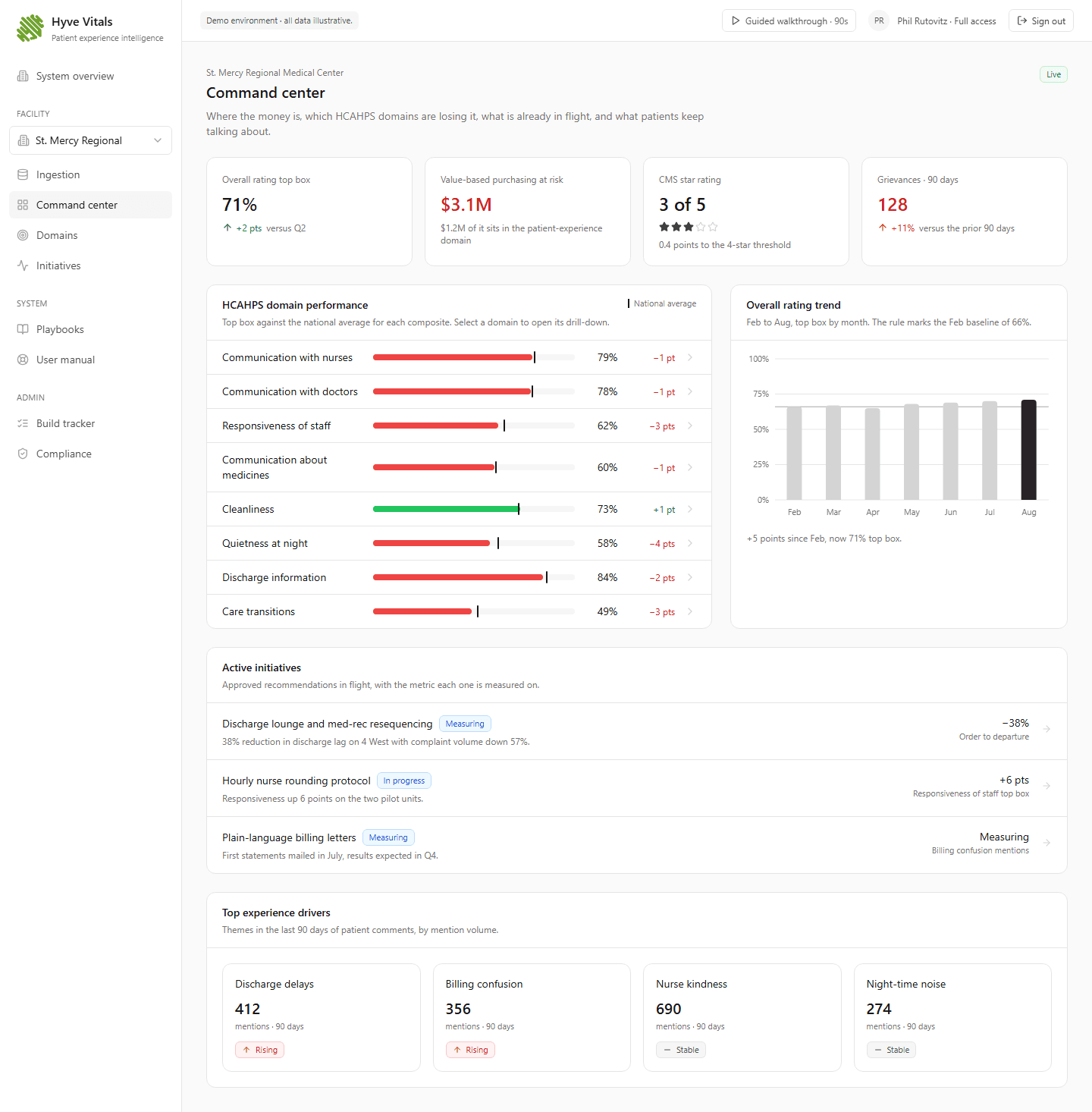
The model runs the whole arc: system-wide exposure, down to one hospital, down to the single unit carrying the loss, then three independent lines of evidence, a recommendation with a named owner and the clinical sign-off it cannot bypass, and finally the measured result against a baseline.
Proven fixes become playbooks with the evidence pattern that says where else they apply, so the next facility is shown a result rather than a theory.
It carries its own ninety-second guided walkthrough, which routes through the screens in order and marks what to look at. That is a specification you can hand someone, not a document they have to read.
Stack
On screen
Running
What it is, and what it is not
A prototype, and labelled as one on its own screens. There is no backend, no database and no authentication in front of real data: every figure is served from typed files, and the hospital, the units and the patient comments are all invented. No protected health information exists in it and none ever did.
That is the point rather than a shortcut. The expensive failures in a system like this are specification failures, and this is the cheapest possible way to find them — while the answer is still an argument about a data model instead of a rebuild.
- It is a model, and it says so on every screen
- The demo banner is part of the interface, not a caveat in a footer, and the hospital, units and comments are all invented.
- The domain chain is the deliverable
- Score to cause to owner to measurement to replication, walkable end to end across four facilities and eight survey domains.
- The specification can be handed over
- A guided walkthrough routes through the screens in order and marks what to look at, reading the figures from the data rather than from a script.
What you take
Discovery produces something like this. A specification you can open and operate is worth more than one you have to imagine, and it surfaces the disagreement early, when changing your mind is free.
Building the model this way also proves the domain was understood. The interface only holds together if the chain underneath it — score, cause, owner, measurement, replication — was modelled correctly first.
Ownership
A design artifact rather than a delivered system. It exists to be clicked through, argued with and changed before anything is built for real.
Start with a call
Twenty minutes to work out whether there is something here worth building. If there is not, I will tell you.