Execution platform with AI advisors, at reallydoing.it
LiveRPM
Most business owners know what to do. The gap is follow-through. RPM turns a stated ambition into a measurable plan, then puts an execution system and a set of AI advisors behind it.
The problem
Advice is cheap and execution is not. A platform that only generates plans produces another document nobody returns to, so the product had to own the whole loop: set the goal, break it down, work it, review it, and be asked about it tomorrow.
The commercial model made that harder. Six tiers from free to business, advisor access gated per tier, and teams that people join and leave. Billing that is decorative at that point becomes a support queue.
The system
A goal is decomposed into a structured breakdown, objectives with weighted key results, and a sprint backlog. Progress rolls up automatically, and any override carries a reason and an audit trail rather than silently changing a number.
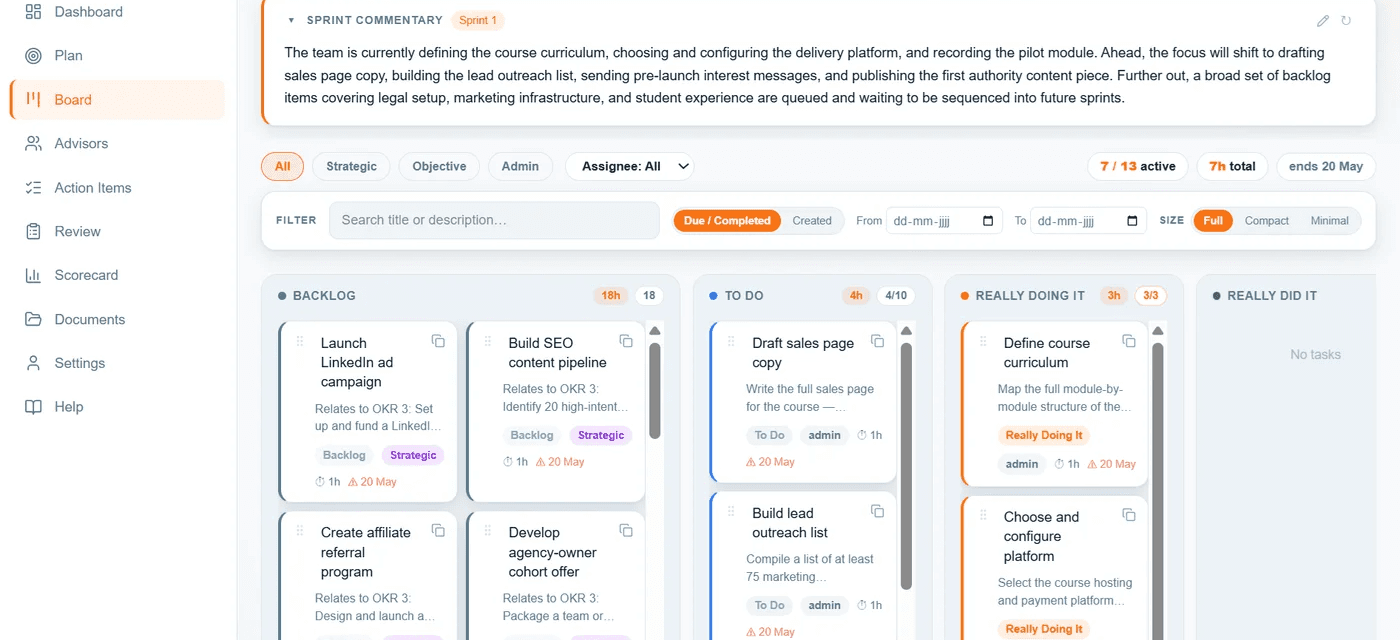
Execution runs on a Kanban board with a hard limit of three tasks in progress, which is a product opinion rather than a setting.
Ten role-specific AI advisors answer in context of the user's live goals and sprint. On the top tiers all of them can be asked the same question at once, with responses labelled by role.
Stack
On screen
Running
In production
Live on subscription with teams, invitations and four server-enforced role levels. Accepting a team invitation cancels the member's individual subscription with proration and inherits the team tier — the kind of billing edge case that decides whether a product can be sold to more than one person at a time.
Error monitoring and product analytics were wired in from the start, so failures surface before a user reports them.
- Billing is wired to what actually happens
- Accepting a team invitation cancels the member's individual subscription with proration and inherits the team tier.
- Permissions are enforced where they cannot be bypassed
- Four role levels enforced server-side with audit logging; daily check-ins rate-limited per goal on the server, not in the client.
- Failures surface before a user reports them
- Sentry error monitoring and product analytics from first deploy.
What you take
This is what the unglamorous half of a SaaS build looks like: auth with MFA, tier gating, proration, role permissions enforced on the server rather than in the interface, and an audit trail on anything a user can override. The system design and the build are mine; the venture has a co-founder.
AI sits in the advisory layer and nowhere near the billing or permission logic. That separation is deliberate and it is the same judgement applied on every system here.
Ownership
A venture I co-founded and build. It is licensed and operated rather than transferred; a customer's data within it is theirs and can be exported in full on request.
Start with a call
Twenty minutes to work out whether there is something here worth building. If there is not, I will tell you.